
Description
Smart IoT Weather Monitoring System – EEE Final Year Project
- Introduction to the Smart IoT Weather Monitoring System
- Benefits of a Smart IoT Weather Monitoring System
- Key Components of the Smart IoT Weather Monitoring System
- Step-by-Step Implementation Guide
- Applications and Use Cases
- Conclusion
1. Introduction to the Smart IoT Weather Monitoring System
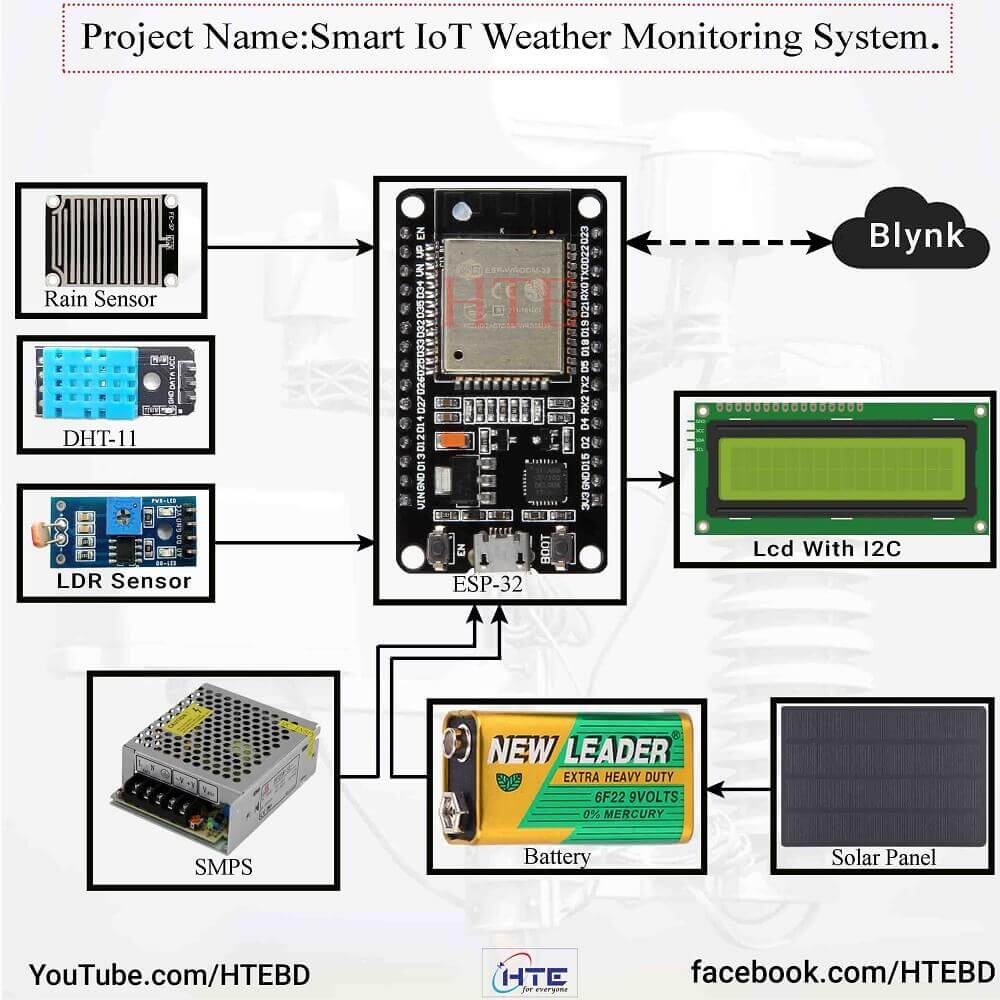
The Smart IoT Weather Monitoring System is an innovative project idea, perfect for EEE final year students looking to showcase their technical expertise in IoT and environmental monitoring. This system is designed to collect and analyze real-time weather data, offering valuable insights into environmental conditions such as temperature, humidity, rainfall, and light intensity. By leveraging the ESP-32 microcontroller and various sensors, this project demonstrates practical applications of IoT in real-world scenarios.
2. Benefits of a Smart IoT Weather Monitoring System
Implementing a Smart IoT Weather Monitoring System comes with numerous benefits:
- Real-time Monitoring: Provides immediate data collection and analysis, enhancing decision-making for weather-dependent operations.
- Remote Accessibility: With cloud integration through platforms like Blynk, users can access weather data from anywhere.
- Energy Efficiency: Integrating a solar panel ensures the system operates independently and sustainably.
- Educational Value: This project equips students with hands-on experience in IoT, programming, and circuit design.
3. Key Components of the Smart IoT Weather Monitoring System
Creating a Smart IoT Weather Monitoring System involves assembling several key components. Here is a breakdown of what you need:
H2: Essential Components
- ESP-32 Microcontroller: The core of the project, handling data collection and transmission.
- DHT-11 Sensor: Measures temperature and humidity with reliable accuracy.
- LDR Sensor: Detects light intensity, useful for assessing day and night cycles.
- Rain Sensor: Monitors rainfall, contributing to precipitation data collection.
- LCD with I2C Module: Displays real-time weather data for local monitoring.
- Solar Panel and Battery: Power the system for energy efficiency and uninterrupted operation.
- Blynk App: Enables remote data visualization and control through cloud integration.
H3: Supporting Components
- SMPS (Switched-Mode Power Supply): Provides stable power input to the microcontroller and sensors.
- Wiring and Connectors: Connect all components seamlessly for data transmission and power supply.
4. Step-by-Step Implementation Guide
H2: How to Build Your Smart IoT Weather Monitoring System
Step 1: Assemble the Components
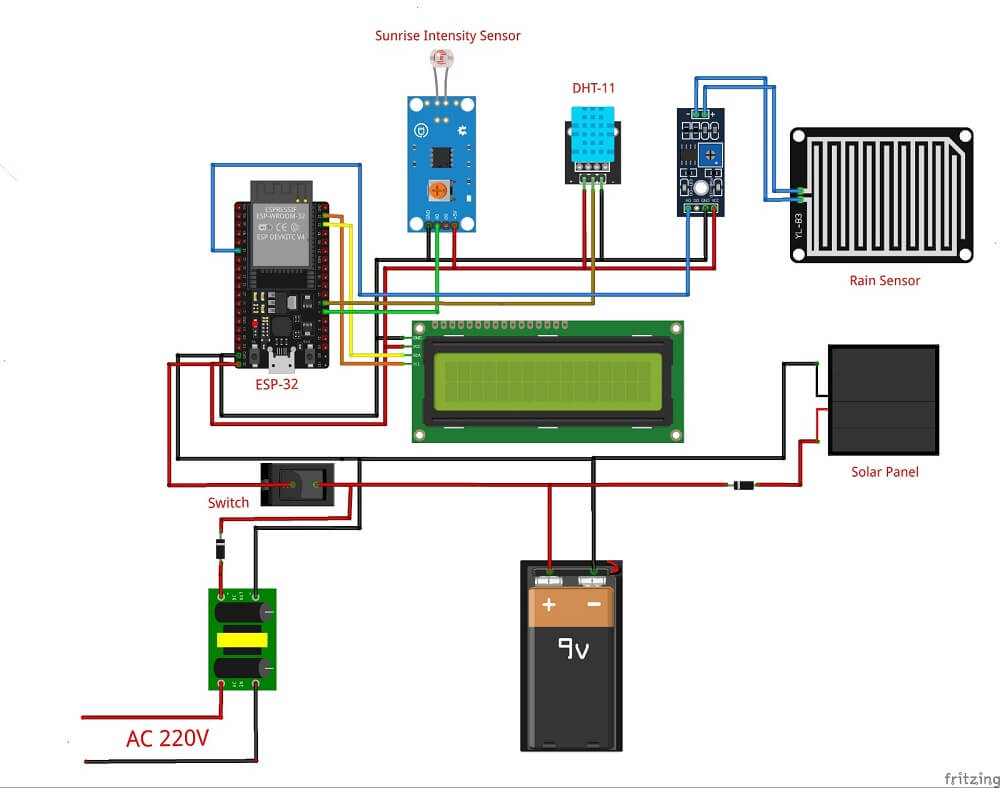
Connect the ESP-32 to the DHT-11, LDR sensor, rain sensor, and the LCD module. Use the wiring diagram for a detailed overview.
Step 2: Code the ESP-32 Microcontroller
Program the ESP-32 to collect sensor data using Arduino IDE. Include code snippets to interface with sensors and display outputs on the LCD and Blynk cloud platform.
Step 3: Integrate with Blynk
Connect your ESP-32 to Blynk for real-time data monitoring. Follow Blynk’s guide to set up a project for seamless cloud integration.
Step 4: Power Up and Test the System
Ensure the solar panel is correctly installed and connected to the battery for continuous power. Run tests to verify sensor readings and data transmission to the Blynk app.
5. Applications and Use Cases
H2: Real-World Applications of Smart IoT Weather Monitoring Systems
- Agricultural Monitoring: Helps farmers track weather conditions, optimizing irrigation and crop care.
- Urban Planning: Assists city planners in designing systems resilient to varying weather conditions.
- Smart Homes: Integrates with home automation systems for weather-based adjustments in HVAC or lighting.
H3: Educational and Research Applications
- University Projects: Ideal for students pursuing electrical, electronics, or IoT-focused degrees.
- Research and Development: Provides a platform for studying environmental changes and testing innovative IoT concepts.
6. Conclusion
The Smart IoT Weather Monitoring System is an impactful project that not only highlights the capabilities of IoT technology but also showcases students’ skills in combining hardware and software for meaningful applications. This project prepares students for careers in IoT, electronics, and environmental engineering, making it a valuable addition to any EEE final year curriculum.
External DoFollow Links:
Internal Link: Visit our Projects Overview page for more innovative EEE project ideas.
Reviews
There are no reviews yet.