

Description
- Introduction to IoT-Based Voltage Controlling
- Project Features and Benefits
- Components Used in the Project
- Working Principle of the System
- Advantages of IoT-Based Voltage Control
- Applications
- Conclusion
Introduction to IoT-Based Voltage Controlling
Voltage fluctuations can lead to significant damage to electrical appliances, making IoT-based under voltage and over voltage controlling systems essential. This project, ideal for EEE final-year students, showcases the integration of IoT with microcontroller technology to monitor and manage voltage irregularities. Using an ESP-32 module, GSM communication, sensors, and visual alerts, this system ensures real-time protection and monitoring.
Project Features and Benefits
Key Features:
- Real-time monitoring of voltage levels using IoT.
- Alerts through buzzer, LEDs, and GSM module.
- Automatic power cutoff for protection.
- Integration of an LCD for live data display.
- Mobile phone notifications for critical voltage fluctuations.
Benefits:
- Ensures the safety of sensitive electrical devices.
- Easy to implement with commonly available components.
- Scalable for industrial applications.
Components Used in the Project
The IoT-based under voltage and over voltage controlling system comprises the following key components:
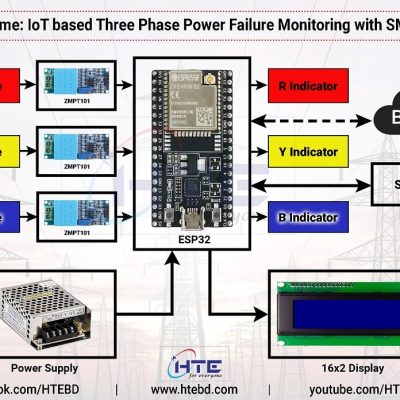
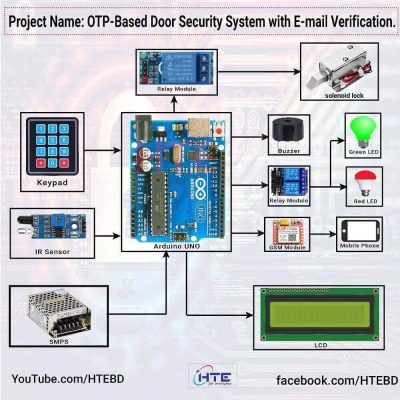
- ESP-32 Module: Central microcontroller for processing and communication.
- Voltage Sensor: Detects input voltage levels.
- Current Sensor: Monitors current flow.
- GSM Module: Sends voltage alerts to the user’s mobile device.
- Voltage Regulator: Maintains steady output voltage for the system.
- SMPS (Switched-Mode Power Supply): Provides reliable power.
- Buzzer, Green & Red LEDs: Indicates normal and abnormal voltage conditions.
- LCD Display: Shows real-time voltage readings.
Working Principle of the System
- Voltage Monitoring:
The system uses the voltage sensor to detect under-voltage or over-voltage conditions. The readings are processed by the ESP-32. - Real-Time Alerts:
When voltage levels deviate from the set thresholds, the GSM module sends alerts to the connected mobile phone. Simultaneously, the buzzer and LEDs provide local alerts. - Power Control:
If the fluctuation persists, the servo lock activates to cut off power, ensuring the safety of connected devices. - Data Display:
The LCD screen continuously displays the voltage and current readings, offering real-time feedback.
Advantages of IoT-Based Voltage Control
- Enhanced Safety: Protects electrical equipment from voltage fluctuations.
- Remote Monitoring: Alerts via GSM allow users to monitor voltage from anywhere.
- Energy Efficiency: Helps identify and mitigate power losses.
- Cost-Effective Solution: Uses affordable and readily available components.
Applications
This project has wide-ranging applications, including:
- Industrial Automation: Monitoring voltage in factories.
- Home Automation: Protecting household appliances.
- Renewable Energy Systems: Ensuring stable voltage supply in solar and wind power setups.
- Educational Projects: Perfect for final-year engineering students.
Internal and External Links
Internal Links:
External Links:
Conclusion
The IoT-based under voltage and over voltage controlling project is a reliable and innovative solution for monitoring and managing voltage fluctuations. With its real-time alert system, automatic power cutoff, and IoT integration, it is a must-have project for EEE final-year students aiming to make a significant impact in the field of electrical engineering.
Embrace the power of IoT and protect your electrical systems today!
Reviews
There are no reviews yet.